Brain teasers
How to Read a Synastry Chart: A Step-by-Step Guide With Practice Puzzles
Two birth charts, one geometry puzzle. Turn signs into degrees, measure the angles between planets, name the aspects, then test yourself on six practice puzzles.
 HinToday Team Updated 10 min read
On this page
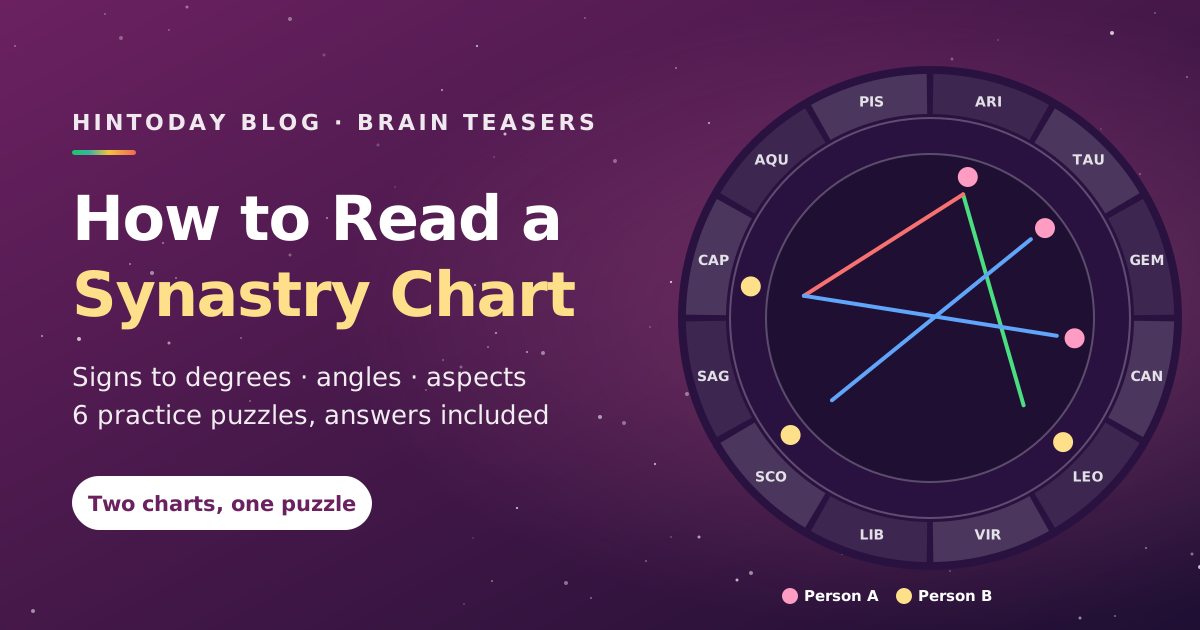
Open a synastry chart for the first time and it looks like a tangle: two rings of symbols and a web of colored lines across the middle. It's less mysterious than it looks.
Whatever you make of astrology, reading a synastry chart is a tidy little geometry puzzle. Every line in that web is just an angle between two planets, and you can work each one out with subtraction.
This guide walks through the method in five steps, shows the one trap that catches most beginners, and ends with six practice puzzles, each with a hint and the answer behind a tap.
What you'll learn
- What a synastry chart shows, and what you need to make one
- How to turn any sign position into a single number of degrees
- How to measure the angle between two planets and name the aspect
- The sign-count shortcut, and the out-of-sign trap that breaks it
- Six practice puzzles to test yourself, answers included
What is a synastry chart?
A synastry chart compares two people's birth charts. One person's planets are placed around the other's, and the angles between the two sets, called aspects, are what astrologers read as the relationship's points of ease and friction.
You'll usually see it drawn as a double wheel: one person's planets on the inner ring, the other's on the outer ring. The lines in the middle connect pairs of planets that form an aspect.
Synastry can also look at house overlays, where one person's planets land in the other's houses. That part needs exact birth times, so this guide sticks to aspects, which you can read with nothing more than signs and degrees.
What you need
- Both people's birth details. Date, time and place of birth. The time matters most for the Moon, which moves about 13° a day.
- A synastry chart. Enter both sets of birth details into SynastryChart to calculate the synastry chart. You'll get each planet's sign and degree, which is all the steps below need.
- Pen and paper, or a notes app, for the subtraction.
Step 1: Turn every sign into degrees
The zodiac is a 360° circle split into twelve signs of 30° each, starting from Aries at 0°. Any position, like "18° Taurus", becomes a single number: the sign's starting degree plus the degrees within the sign.
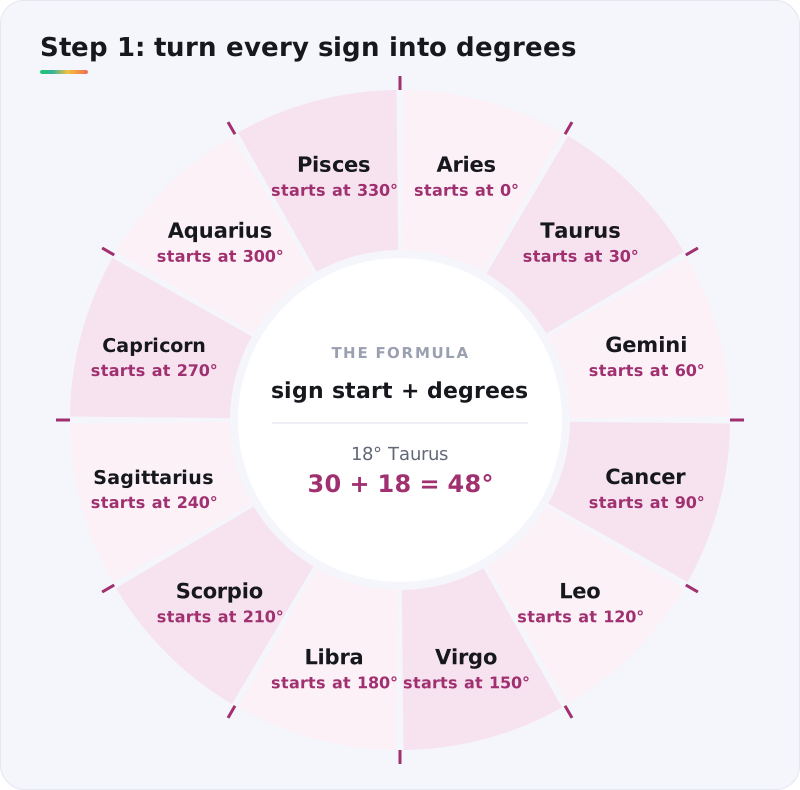
Memorize four anchors and the rest fall into place: Aries 0°, Cancer 90°, Libra 180°, Capricorn 270°.
Step 2: Measure the angle
Take the two numbers and subtract the smaller from the larger. If the answer is more than 180°, subtract it from 360°, because you always want the shorter way around the circle.
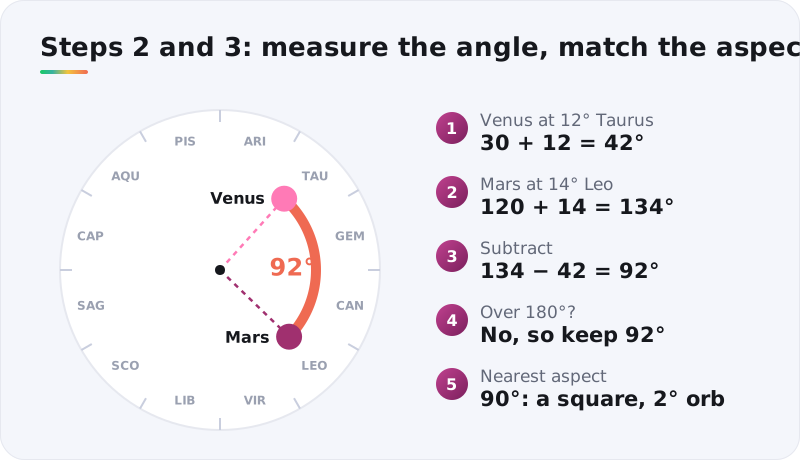
The formula
angle = |position A − position B|
if angle > 180: angle = 360 − angle
Step 3: Match the aspect
Compare the angle with the five major aspects. The gap between your angle and the exact aspect is called the orb. A smaller orb means a tighter, stronger aspect.
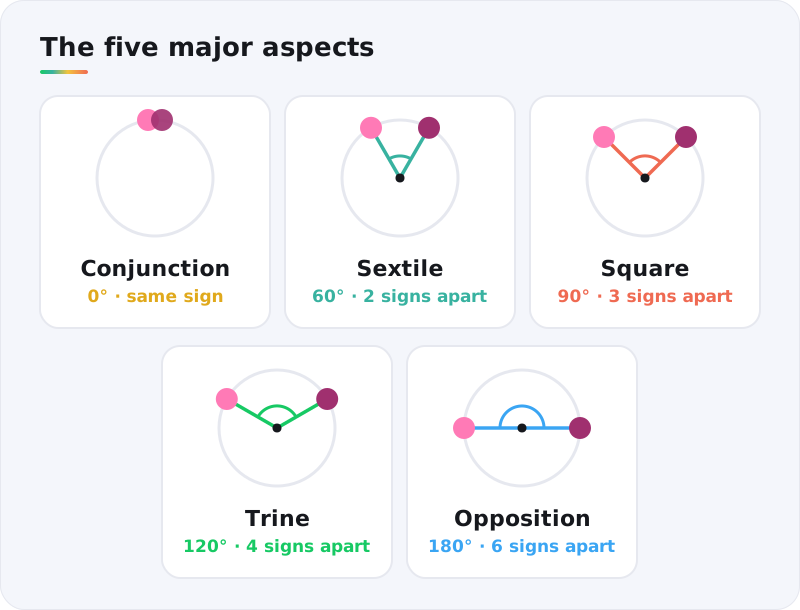
| Aspect | Angle | Common orb | Traditional reading |
|---|---|---|---|
| Conjunction | 0° | up to ~8° | Merging; intensifies both planets |
| Sextile | 60° | up to ~6° | Easy, friendly support |
| Square | 90° | up to ~8° | Friction that pushes for growth |
| Trine | 120° | up to ~8° | Natural flow and ease |
| Opposition | 180° | up to ~8° | Attraction and tension, a balancing act |
Orb conventions vary between astrologers, so pick one set and use it for every pair. The practice puzzles below use a simple 6° for everything.
Step 4: Use the sign-count shortcut, and know its trap
Once you've done a few by hand, you'll notice a pattern. Count how many signs apart two planets are: 0 is a conjunction, 2 a sextile, 3 a square, 4 a trine and 6 an opposition. Planets in signs of the same element are usually in trine; signs of the same modality usually square or oppose each other.
The shortcut is fast, and it's right most of the time. But it breaks when planets sit near the edges of their signs.
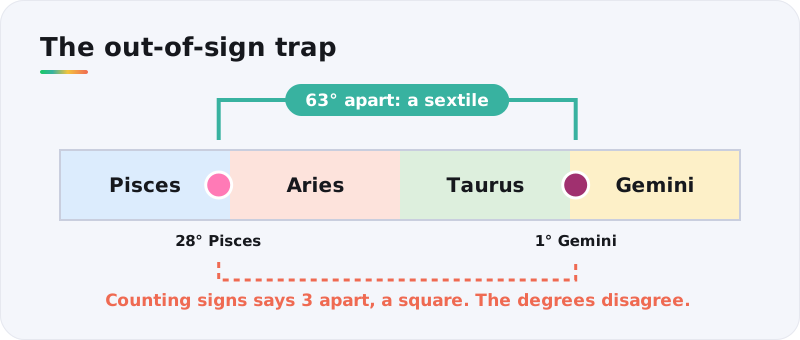
Astrologers call this an out-of-sign aspect. 28° Pisces and 1° Gemini are three signs apart, which looks like a square, but they're only 63° apart: a sextile with a 3° orb. When either planet is in the first or last few degrees of its sign, do the subtraction.
Step 5: Check the key pairs first
Two charts with ten planets each give you a hundred possible pairs. Traditional synastry readings start with a handful:
- Sun–Moon: read as the core of compatibility, identity meeting emotion.
- Venus–Mars: read as attraction and chemistry.
- Moon–Moon: read as emotional rhythm and day-to-day comfort.
- Mercury–Mercury: read as how easily the two of you talk things through.
Check these pairs in both directions, A's Sun to B's Moon and B's Sun to A's Moon, before you go hunting through the rest of the grid.
6 practice puzzles
Time to test yourself. Use the steps above and a 6° orb. Each puzzle has a hint and an answer; open them only when you need to. When you've finished, run two real birth charts through a synastry chart calculator like SynastryChart and find the aspects by hand before you look at the lines.
Puzzle 1: The shortcut
- Easy
- Sign count
One person's Sun is in Leo; the other's Moon is in Sagittarius. Using the sign count only, what aspect do they form?
Hint
Count forward from Leo: Virgo, Libra, Scorpio…
Answer
A trine. Leo to Sagittarius is four signs, and both are fire signs.
Puzzle 2: Degree math
- Easy
- Subtraction
Venus at 8° Gemini, Mars at 10° Libra. What's the angle, and which aspect is it?
Hint
Gemini starts at 60°, Libra at 180°.
Answer
122°, a trine with a 2° orb. 60 + 8 = 68 and 180 + 10 = 190, so 190 − 68 = 122.
Puzzle 3: The wrap-around
- Medium
- 360° rule
Moon at 20° Pisces, Sun at 18° Taurus. What aspect do they make?
Hint
The raw subtraction comes out over 180°. Go the short way round.
Answer
A sextile, 58° apart with a 2° orb. Pisces 20° is 350 and Taurus 18° is 48. 350 − 48 = 302, which is over 180, so 360 − 302 = 58.
Puzzle 4: The trap
- Medium
- Out-of-sign
One Mercury is at 29° Aries, the other at 2° Leo. The sign count says one thing. What do the degrees say?
Hint
Aries to Leo is four signs, which suggests a trine. Now do the subtraction.
Answer
A square, 93° apart with a 3° orb. 29° Aries is 29 and 2° Leo is 122, so 122 − 29 = 93. The sign count said trine; it's an out-of-sign square.
Puzzle 5: Trick question
- Medium
- Orbs
Moon at 5° Cancer, Venus at 20° Leo. Which major aspect do they form?
Hint
Work out the angle, then check how far it is from each of the five.
Answer
None. 95° and 140° are 45° apart, which is 15° from a sextile and nowhere near the others. (45° is a minor aspect called a semi-square, which most beginners skip.)
Puzzle 6: The full grid
- Hard
- Nine pairs
Person A has the Sun at 15° Aries, the Moon at 8° Cancer and Venus at 22° Taurus. Person B has the Sun at 13° Leo, the Moon at 10° Capricorn and Mars at 20° Scorpio. With a 6° orb, there are exactly four aspects between them. Find all four.
Hint
In degrees, A is Sun 15, Moon 98, Venus 52, and B is Sun 133, Moon 280, Mars 230. Two of the four aspects are oppositions.
Answer
A's Sun trine B's Sun (118°, 2° orb). A's Sun square B's Moon (95°, 5° orb). A's Moon opposite B's Moon (178°, 2° orb). A's Venus opposite B's Mars (178°, 2° orb).
The other five pairs miss every major aspect by more than 6°.
5 mistakes beginners make
1. Forgetting the wrap-around
An angle over 180° is the long way round. Subtract it from 360° every time.
2. Trusting the sign count near sign edges
Planets in the first or last few degrees of a sign are where out-of-sign aspects hide. Do the subtraction instead.
3. Using huge orbs
Stretch the orbs far enough and nearly every pair becomes an aspect. Keep them modest and consistent, and the strongest contacts stand out.
4. Guessing the birth time
The Moon moves about 13° a day, so a wrong birth time can move it into a different aspect, or a different sign. If a time is unknown, treat the Moon's aspects as approximate.
5. Reading one aspect on its own
A single square doesn't sum up a relationship. Synastry readers look at the whole pattern: which pairs connect, how tightly, and how the easy and difficult contacts balance out.
Wrapping up
Signs to degrees, subtract, take the short way round, match the aspect, and double-check anything near a sign edge. That's how to read a synastry chart without memorizing a single chart diagram.
If you enjoyed the puzzles, try our zodiac puzzles next: seven star-sign brain teasers with the same hint-then-answer format. And for something completely different, today's Contexto answer is a puzzle about distance too, just measured in meaning instead of degrees.