Word skills
How to Learn New Words From Daily Word Games: A 10-Minute Routine
Daily word games hand you new words every morning. This five-step routine uses text-to-speech, speech-to-text and spaced review to make them stick.
 HinToday Team Updated 10 min read

On this page
Every morning, daily word games hand you words you'd never pick yourself. Spelling Bee accepts words you didn't know existed. Connections hides a second meaning in its purple group. Then you close the tab, and by lunch the word is gone.
Solving and learning feel like the same thing, but they aren't. Spotting a word in a grid is not the same as being able to say it, spell it and use it in a sentence.
This guide is a 10-minute routine that closes the gap. It uses two voice tools, text-to-speech to hear a word and speech-to-text to check you can say it, plus the oldest trick in memory research: coming back to it later. It's the fastest way we know to learn new words from the games you already play.
What you'll learn
- Why solving a puzzle doesn't make a word stick
- A five-step, 10-minute routine you can run after any daily game
- Where the best new words hide in Spelling Bee, Connections, Strands and Wordle
- How to check your pronunciation with speech-to-text
- A simple review schedule that keeps new words from fading
Why solving isn't the same as learning
Word games mostly train recognition. You spot a word among some letters or in a grid. Using a word takes recall: pulling it out of memory, saying it, and fitting it into a sentence.
Testing yourself beats re-reading. In a well-known 2006 study, students who practiced recalling a passage remembered more of it a week later than students who simply re-read it (Roediger & Karpicke, 2006).
Two more findings shape the routine. Saying a word out loud helps you remember it better than reading it silently, which psychologists call the production effect (MacLeod et al., 2010). And reviews spread over several days beat the same study time crammed into one sitting: the spacing effect (Cepeda et al., 2006).
The routine below uses all three: recall, your own voice, and spacing.
What you need
You need three things to learn new words this way, and you probably have two already.
- Today's answers. Our answer pages for Spelling Bee, Connections, Strands and Wordle show the full solution once you've played. The Spelling Bee page also gives a short definition for every word.
- Text-to-speech and speech-to-text. AnySpeech does both: it reads text aloud and turns what you say into text. Steps 2 to 5 use one or the other.
- A word list. A notes app, a paper notebook or a spreadsheet. One line per word, with the date you added it.
The 10-minute routine to learn new words
Run it right after your daily games, while the words are still fresh.
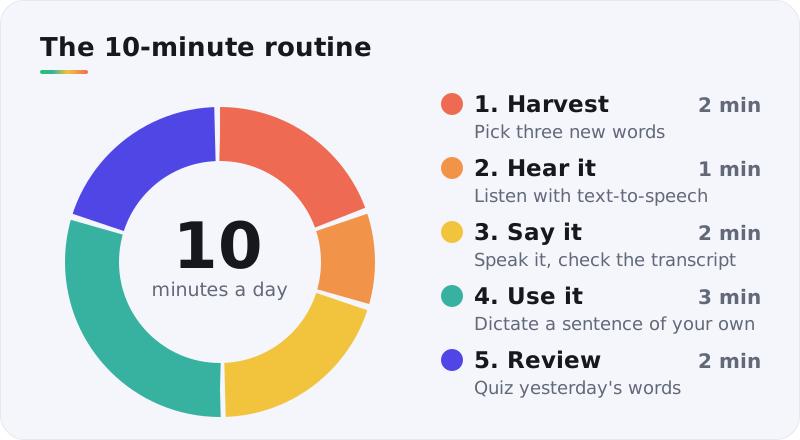
Step 1: Harvest three words (2 minutes)
Open today's answers and pick three words you couldn't define with confidence. Three is enough. Go past five and the routine stops being a ten-minute habit.
Pick words you might actually use. "Lucid" is worth learning. A plant genus you'll never meet again isn't.
Step 2: Hear it (1 minute)
Paste the word and a short example sentence into text-to-speech and listen two or three times. Notice where the stress falls: LU-cid, not lu-CID.
Text to paste
[word]. ... [word]. ... [a short sentence that uses the word].
Step 3: Say it, check it (2 minutes)
Say the word in a full sentence into a speech-to-text tool like AnySpeech, then read the transcript. If your word shows up, your pronunciation is clear enough. If something else shows up, go back to step 2. There's more on getting this check right below.
Step 4: Use it (3 minutes)
Dictate one sentence of your own that uses the word, ideally about your own life: "After coffee, my thinking is a lot more lucid." Read the transcript back and check the word means what you think it means.
If the sentence feels forced, try another. This is the step that turns recognition into recall, so it gets the most time.
Step 5: Review (2 minutes)
Have text-to-speech read out the words that are due for review, one at a time. Pause after each, say what it means and spell it out loud, then check your list. The schedule is in the spaced review section.
Try it tomorrow: after your daily games, pick one word and run all five steps on it. One word takes about three minutes, so three words fit comfortably in ten.
Where the new words hide, game by game
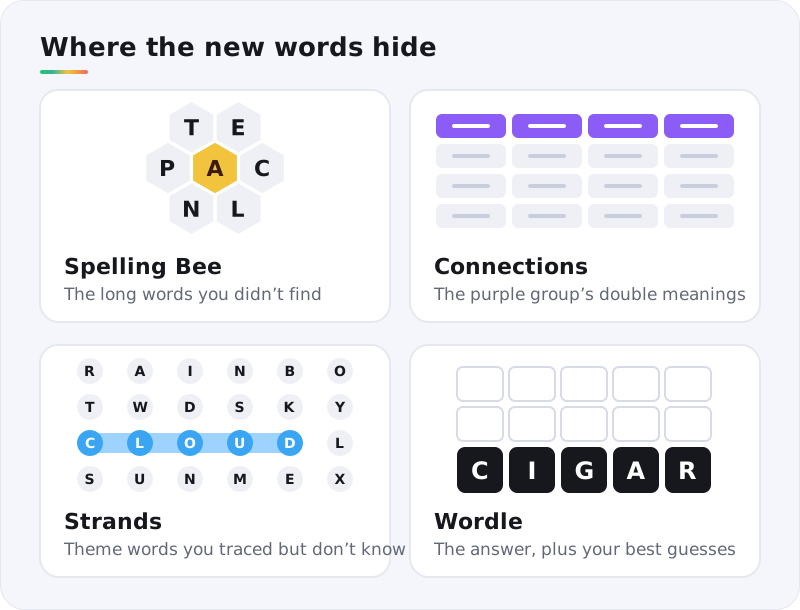
Spelling Bee
Every answer has at least four letters, uses only the seven letters on the board, and always includes the center one. The pangrams get the glory, but the best vocabulary hides in the long words you didn't find. Our Spelling Bee answers list every accepted word with a short definition, which makes harvesting quick.
Connections
Sixteen words, four groups, and the purple group is usually the trickiest. It often leans on a second meaning or wordplay, so familiar words show up in unfamiliar senses. Harvest the meaning, not just the word: "pitch" as in a sticky, tar-like substance counts as new. Our Connections hints explain each group's link.
Strands
Every board hides a set of theme words plus a spangram that runs across the grid. Themes often pull in specialist vocabulary, such as fabrics or cooking terms, which makes them good harvest material. See today's Strands answers.
Wordle
One five-letter answer a day, usually a common word. The learning is often in your guesses: the valid words you typed and couldn't define. Harvest one of those instead. Today's Wordle answer is a tap away.
Letter Boxed and Contexto
They work too. Letter Boxed rewards long, unusual words, and Contexto is all about meaning, so its closest words make ready-made synonym sets.
Say it, check it: pronunciation with speech-to-text
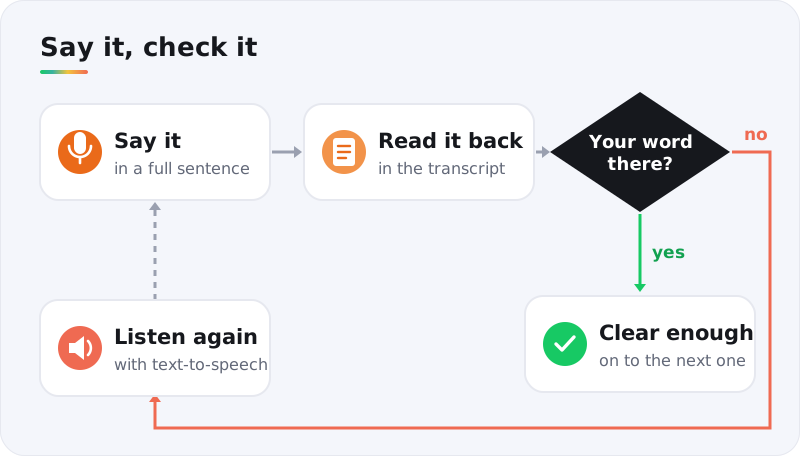
Speech-to-text is a fair, impatient listener. It doesn't know which word you meant, so if it writes yours, you said it clearly. Four habits make the check reliable.
Say it in a full sentence
Transcription uses context to choose between similar-sounding words. A full sentence gives it the same context a real listener would have.
Use a quiet room and a normal pace
Background noise and rushing cause plenty of misses that have nothing to do with your pronunciation. Speak the way you would to a friend across a table.
Know its blind spots
Homophones such as flour and flower sound identical, so a transcript can't tell you which one you meant. For those, check that the sentence makes sense rather than the spelling.
Treat it as a check, not a verdict
A matching transcript means you're understandable. It doesn't mean every vowel is perfect. For fine-tuning, play the text-to-speech version next to a recording of yourself.
Pro tip: if a word fails three times in a row, the problem is usually stress, not sounds. Listen again for which syllable is loudest, and copy that.
Spaced review: the part everyone skips
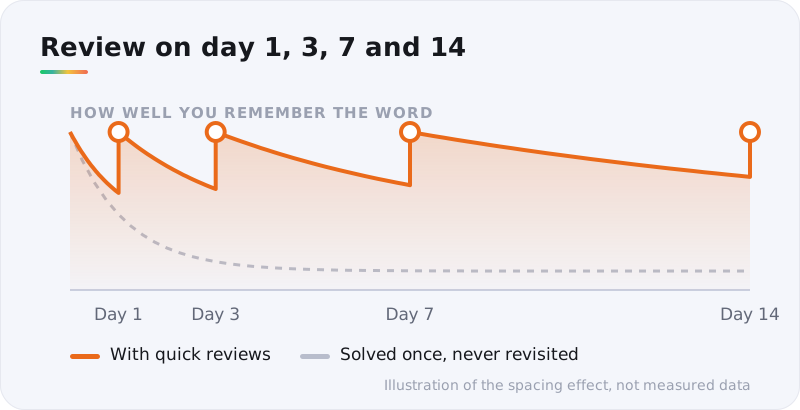
A word you meet once fades fast. Short reviews, spread out, slow that fade a little more each time.
Use a simple schedule: review each word on day 1, day 3, day 7 and day 14 after you harvest it. Each review takes seconds. Hear it, say what it means, spell it.
Date every word in your list and the schedule runs itself. Each morning, review the words from yesterday, three days ago, a week ago and two weeks ago. After day 14, move the word to a "known" list, and bring it back only if it trips you up in a puzzle.
What the review load looks like
At three new words a day, the reviews build up for two weeks and then level off. Here's the count, worked out from the day 1, 3, 7 and 14 schedule:
| Day | New words | Words to review | Batches due |
|---|---|---|---|
| Day 1 | 3 | 0 | None yet |
| Days 2–3 | 3 | 3 | Yesterday's |
| Days 4–7 | 3 | 6 | Yesterday's + 3 days ago |
| Days 8–14 | 3 | 9 | + a week ago |
| Day 15 on | 3 | 12 | + two weeks ago |
The load never goes above 12 words a day. At about ten seconds each, that's two minutes, which is exactly what the routine sets aside.
Make it a habit, not a project
A routine only works if it survives a busy week. Three small choices make the difference.
- Attach it to the game. Don't schedule a separate study time. The moment you finish your daily puzzles, start step 1. The game becomes the reminder.
- Keep one list. Every word, from every game, goes in the same place with its date. Scattered notes are where new words go to die.
- Shrink, don't skip. On a bad day, harvest one word instead of three, or do only the review. A short day keeps the streak; a skipped day starts the slide.
Tips for language learners
If English isn't your first language, daily word games are a sneaky-good way to learn new words. The vocabulary is real, current and chosen to be fair.
- Start with Wordle. One common word a day is a gentle pace.
- Use Connections for idioms and double meanings. The purple group is a free daily lesson in how English words stretch.
- Spend extra time on step 3. Speech-to-text gives you a neutral listener at any hour, which is exactly what pronunciation practice needs.
- Keep step 4 personal. Sentences about your own life are easier to remember than textbook examples.
Want to turn your new words into games for friends? Our guide to audio puzzles with AI voices shows how to make spoken riddles and anagrams by ear.
5 mistakes that stall your vocabulary
1. Harvesting too many words
Five a day feels ambitious on Monday and turns into a chore by Thursday. Three is plenty.
2. Only reading definitions
Reading a definition is recognition again. The word sticks when you say it and use it.
3. Skipping your own sentence
A definition without a sentence of your own has nothing to hang on. Step 4 is the one to protect when you're short on time.
4. Trusting the transcript on homophones
Speech-to-text can't hear the difference between flour and flower. Check the meaning, not the spelling.
5. Never reviewing
Without days 1, 3, 7 and 14, a new word rarely survives the week. Two minutes a day fixes that.
Wrapping up
Solve, then spend ten minutes: harvest three words, hear them, say them, use them, and review them on days 1, 3, 7 and 14. That's the whole routine for learning new words from the games you already love.
Start with today's Spelling Bee answers, where the definitions are already waiting.